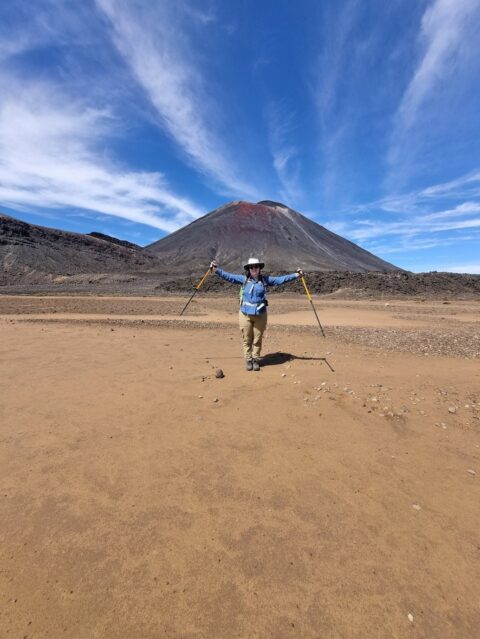
Maia Kidd
2024 recipient of the Dr Eileen Fair Earth Science PhD ScholarshipResearch topic: Hydrothermal alteration induced changes of volcanic rock properties
Maia’s cutting-edge work in volcanic geology could contribute to better ways of assessing risks associated with altered volcanic rocks, by improving our understanding of how hydrothermal alteration affects volcanic rock behaviour, which can help refine hazard models for natural disasters in the future.
Maia’s research focuses on understanding how volcanic rocks change when exposed to hydrothermal alteration and how these changes affect their physical properties at different scales. She is investigating how hydrothermal systems impact the physical and mechanical properties of volcanic rocks using samples from Ruapehu, Tongariro, and Whakaari. A key part of this research involves using a powerful imaging method – synchrotron radiation micro-computed tomography (MCT) – to examine altered rocks in very fine detail.
Hydrothermal systems form when underground fluids interact with the volcanoes’ magma system to produce hot acidic fluids which move through the ground until reaching the surface, forming hot springs and lakes. As these hot acidic fluids move through the rock it causes the minerals and physical make-up of the rock to change; this process is called hydrothermal alteration. Exactly how hydrothermal alteration changes the rock is dependent on the temperature and acidity of the fluid.
The hydrothermal systems on Ruapehu, Tongariro, and Whakaari are unique and cause different types of alteration to occur. However, across all three volcanoes all types of alteration occur, so combining samples from all three volcanoes gives an overall picture of how alteration is impacting physical/mechanical properties.
Samples are tested for their porosity (how much of the rock is holes), permeability (how easy fluid can move through the rock), and strength, along with categorising the alteration present, to look in detail at the relationship between alteration and physical properties.
However, volcanoes are not always accessible due to the terrain or danger from eruptions, so collecting samples and lab testing isn’t always possible. Remoting sensing is where instruments are used from a distance, usually planes or satellites, to collect valuable information about the state of the volcano. One such technique is reflectance spectroscopy, where the reflected light is recorded, usually covering a wider spectrum of light than humans can see. The samples from Ruapehu, Tongariro, and Whakaari, and other samples from different volcanoes around the world, were imaged using reflectance spectroscopy and then correlated with lab values for porosity and strength. These data can then be used to build a machine learning model to predict porosity and strength from remote sensing data.
Finally, alteration plays an important role in determining rock strength, generally causing strength to decrease with increasing alteration, but little is known about how the alteration minerals are behaving together at the micro scale during rock fracturing. By using microCT scanning, with resolutions down to 6.5 µm, the rocks inside structure can be imaged. Scans were taken before and after breaking the rock to examine how different alteration types and patterns affected the rock breaking. Maia Kidd completed her Bachelor of Science in Earth Science at the University of Waikato in 2018, where she was awarded the 2017 H.S. Gibbs Prize for Earth Science. She then moved to Christchurch to study at the University of Canterbury for a Master of Science in Geology, where her thesis focused on landscape evolution on the Mamaku Plateau between large scale volcanic eruptions. This thesis earned her the Sir Juluis von Haast Prize for MSc in Geology in 2021. Maia took a break from study for a year and worked in river management at Environment Southland. Since the end of 2022, she has been studying towards her PhD at Massey University.