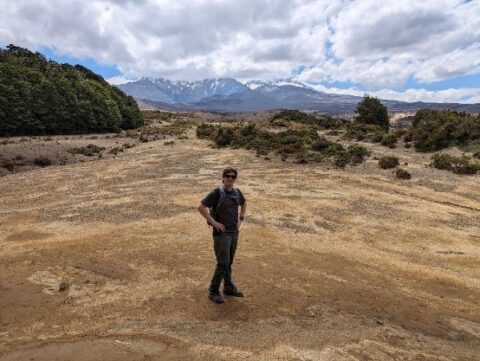
Joseph Fleming
2024 recipient of the Dr Eileen Fair Earth Science Master’s ScholarshipResearch topic: Analysis of Mount Ruapehu tephra deposits from 4.3 to 6.1 ka
Mount Ruapehu is the largest active volcano in New Zealand, with a long eruptive history spanning hundreds of thousands of years. Carefully understanding the history of the volcano and its eruptive characteristics plays a critical role in understanding future behaviour and risks.
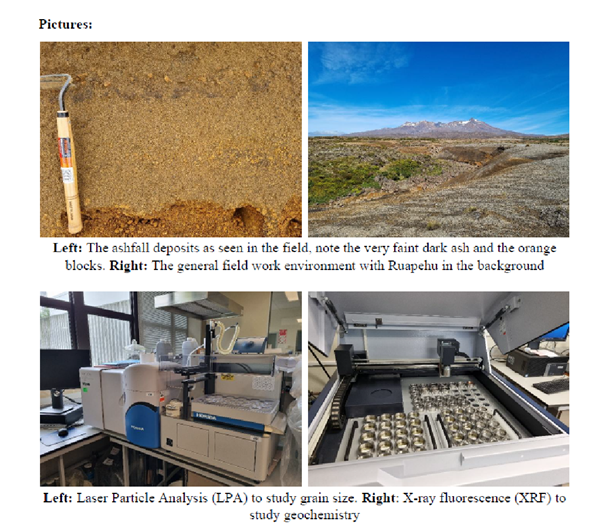
For his master’s thesis, Joseph performed analysis of five ashfall deposits within the eastern ring plain of Mount Ruapehu, dating back around 5,000 years ago. This region was based on previous work conducted by Susan Donoghue in 1991 where these deposits had been identified previously. These ashfall deposits represent volcanic activity during a period of relative dormancy for Mount Ruapehu. Understanding what the volcano was up to within this time period allows us to infer what the early stages of its current eruptive cycle look like. Comparisons can then be made to current activity to uncover trends in how the volcano evolves over time.
Joseph’s analysis included field observations to determine deposit thickness and characteristics within the landscape as well as laboratory analysis through geochemistry, componentry and grain size analysis. This work was then compiled to build a comprehensive picture of what sort of eruptions produced these deposits and how they compare to more recent equivalents.
Of the five ashfall layers analysed, three were deemed “orange lapilli” layers. These were thicker ashfall deposits with larger rocks found within, all with an orange colouration. The other two layers were deemed “black ash layers”. These were very fine-grained, thin ash layers that ranged from a deep black to a pale grey within the environment. All five layers were very thin and were exceptionally difficult to locate within the stratigraphy due to their age and erosion over time. The material was mapped out within the region to estimate deposit volumes and what areas would have been impacted by the eruption.
Joseph’s laboratory work uncovered the geochemistry of the material, with it being designated as basaltic andesite. This material has markedly less silica content than what is usually observed from Mount Ruapehu. This infers that these deposits were the result of less explosive, small-scale eruptions that signalled a “reactivation” of Mount Ruapehu’s volcanic activity where its modern-day crater lake now resides. It also shows trends towards ever-increasing volatility within its eruptive cycle with modern eruptions showing greater explosivity. These findings bridge the gap between known eruptive cycles within Mount Ruapehu’s eruptive history.